Wednesday, March 3, 2010

The World’s Messiest Festivals

Most of the time, when travelers are thinking about going to a foreign country in order to witness a particular festival celebration first-hand, they’re thinking in terms of what festival will help them understand the culture better, or which ones have the most free-flowing alcohol. But if you’re one of those travelers who just wants to get dirty – and I mean really dirty – in order to help the locals celebrate something, then these messy festivals should be right up your alley.

Orange Throwing in Italy

Oranges fly through the air in Ivrea

The town of Ivrea in the Piedmont region of northern Italy may be a quiet town most of the year, but during its annual February carnival things get messy. That’s because the most famous part of Ivrea’s annual carnival is the battle of the oranges. The orange fight of the Carnevale d’Ivrea is said to have originated in the 12th century, when a local woman not only refused to let the local duke sleep with her on her wedding night (a custom at the time), she chopped off his head and thus set off a revolution. Today, the oranges which locals chuck at one another are said to represent the duke’s head. The orange-throwing isn’t a free-for-all, although it might look chaotic – the people of Ivrea are split into 9 teams who attack one another. Some ride high-up in carriages above the crowd (these people are said to represent the guards of the famous beheaded duke), while others throw oranges from below. No matter where they come from, the oranges – thrown with speed – can hurt. If you want to avoid getting hit, wearing a red cap lets the orange throwers know you’re just watching. If you want to get in on the action, you’ll need to join one of the teams (which is easy to do – just volunteer!).

Pumpkin Chucking in Deleware

Because the family that hurls pumpkins together, stays together
The family that hurls pumpkins together, stays together

What symbolizes Autumn more than a pumpkin throwing contest, I ask you? Nothing, I say, and I think the folks behind the World Championship Punkin Chunkin festival would agree. What began in 1986 as a sort of a bet between four friends about who could throw a pumpkin furthest has blossomed into a popular annual event that takes place the week after Halloween each year (great way to get rid of those unwanted holiday decorations). In recent years, as many as 20,000 people have made the pilgrimage to Sussex County in Delaware to either watch pumpkins flying through the air or enter their own apparatus in a bid to chuck their pumpkin the furthest. Now, this isn’t a messy event if you’re just a spectator or even one of the pumpkin chuckers – but if you’re on the clean-up crew? I’d call that a messy festival of the highest order.

Colored Powder Throwing in India

Pretty colors make some people loopy
The pretty colors make some people loopy

As far as most of these messy festivals go, the results can’t exactly be called "pretty." Not so with Holi, the Hindu so-called Festival of Colors that takes place each year in India around the end of February or beginning of March. The second day of Holi is marked by participants (which is everyone) throwing colored powders at one another – so while your clothing may never be the same, the spectacle itself is quite lovely. The powder-throwing, aside from being delightfully fun, has medicinal origins – the powders are made from medicinal herbs which are intended to ward off the fevers and other illnesses which generally come up as the weather changes at that time of year. Along with the powders, water is also thrown, leaving some people with a tie-dye effect on their bodies – at least for a little while. In addition to India, Holi is also celebrated in Nepal, Guyana, Trinidad, and West Bengal, where it’s called Dolyatra. Some reports say that the colored powders and pastes actually contain toxic chemicals these days, so before you decide to take part, be sure to do your research.

Tomato Throwing in Spain

This is also how Heinz makes its ketchup

Food fights are just about the messiest festivals around, and the town of Buñol in Spain holds a doozy every year. Each August on the fourth Wednesday of the month, locals and tourists alike crowd into the town and spend a couple hours hurling tomatoes at one another. The festival is called La Tomatina, and while the tomato-throwing portion is only one part of the whole week-long festival, it’s the only part that anyone outside Spain really knows anything about. There are tours you can join which are organized solely around the tomato food fight, and some even provide the necessary gear you’ll need. Not sure what "gear" I might be referring to? Why I’m talking about goggles, of course. Imagine having to explain to an emergency room doctor in Spain why you’ve got a beefsteak tomato lodged in your eye socket. Oh, and if you’re going to go, either wear something that’s already pink or something you don’t mind ending up pink afterwards.

Water Fight in Thailand

Water flies for the Thai New Year

While you might accidentally pour what’s in your beer glass over your neighbor at the bar when someone shouts "Happy New Year," people in Thailand celebrate their new year by dousing one another with water on purpose. Songkran, the Thai New Year, happens each year in mid-April and is marked by massive water fights. Locals and visitors alike are out in force with buckets, bowls, garden hoses, water guns, elephants (yes, elephants), and any other water-delivery method they’ve got at their disposal – and anyone is fair game. This no-holds-barred water fight originally was just a small amount of water poured over someone’s hands as a sign of respect, but it’s clearly gone beyond that now (although the water is still seen as a sign of respect). In fact, if you’re in Thailand in mid-April you’ll be glad that an all-out water fight is now the traditional way to celebrate the new year, because it’s so hot that being drenched is a welcome relief.

Tomato Fight in Colombia

Colombia's tomato fight looks messier than Spain's
Colombia’s tomato fight looks messier than Spain’s

Having a tomato fight be your country’s messy festival isn’t something the Spaniards have all to themselves. In fact, the town of Sutamarchan in Colombia also has a tomato-throwing festival on its calendar each year. Colombia’s version is called the "Tomatina Colombiana," and it takes place in June. While the Spanish Tomatina festival is decidedly more famous and undoubtedly more of a tourist attraction, the Colombian tomato festival is absolutely no less messy. In fact, judging from some of the pictures, it actually looks a little messier than its Spanish counterpart, in that the tomato mush participants are standing in isn’t just red – it’s brown. (Not sure I want to know why.) There’s not as much information about this tomato fight available out there, so if you’re looking to be among the only tourists at a messy festival, this might be the one to pick.

Water Splashing in China

More water fighting fun, this time in China

Like Thailand’s water festival, China’s also takes place in mid-April to mark the start of the New Year. The water splashing happens in the Yunnan province, and is only part of the whole 3-5 day festival celebrated by the Dai people. As in Thailand, dousing people with water in this Chinese festival has special significance – water is the symbol of holiness and purity, and it’s meant to wash away all the bad things from the previous year so everyone can start the new year fresh. So in this tradition, the more water you get splashed with, the better the outlook for your new year! Budget travelers should love this, as it could save you from needing a place to take a shower for at least a few days. Other things you’ll see if you stick around for more than just the water fight include dragon boat races, fireworks, and traditional dances.

Lotus Throwing in Thailand

Sweepers follow the Buddha's boat collecting lotus flowers
Sweepers follow Buddha’s boat collecting lotus flowers

Okay, I know, throwing lotus flowers doesn’t exactly sound messy. And in comparison to some of the other festivals on this list, it isn’t. But this tradition, which marks the end of the Rub Bua Festival in Samut Prakan, Thailand, could be considered messy if you’re one of the people who’s on clean-up duty. The lotus-throwing portion of the festival is held in October each year, when an image of the Buddha is floated down the river through town. People on either side of the river throw lotus flowers onto the boat carrying the Buddha, and as you can imagine many of them miss the boat (so to speak). There are several smaller boats trailing the Buddha boat, and the people on those smaller crafts are designated to sweep up the flowers that didn’t quite make it and deposit them onto the main boat. Buddhists come from all over Thailand to take part in this festival, which means there are a lot of flying lotus flowers, so watch where you’re going.

Sunday, February 28, 2010

6 Wacky World Festivals

Think flashing strangers or guzzling green beer is wild? Think again. We searched high and low for the craziest festivals on earth and let’s just say, the world is a wacky place. Naked men in sub-prime temps, primate fruit fests, baby purification? You’ve got to see it to believe it. These festivals are crazy. They are bizarre. They are oddly-curious. And we can’t get enough of them. Here are six of the world’s wackiest and yet relatively unknown cultural festivals.

Hadaka Matsuri – The Naked Festival

Happy Naked Men in Japan
Happy (Nearly) Naked Men in Japan

It’s not your late night frat party turned bad, but thousands of Japanese men streaking through town paying tribute to the gods. Every year in Saidaiji, Okayama prefecture men gather with 10-12 of their best buddies, strip down to thong-like loin cloths, toss back sake and jog through the streets purifying their bodies. Sound like fun? Not if you consider this man-fest goes down in February on what is likely to be the coldest night of the year. Heated throughout
with sake and adrenaline, the men jump erratically while chanting "Washoi" before jogging throughout the neighborhood en route to the main shrine. Just when their body temperatures rise, a volunteer tosses cold water on them to further purify their souls. The
groups convene at midnight when two pieces of wood, called shingi, are dropped from the top of the shrine to the groveling men below. They fight it out in hopes of snagging one of the two sticks which promises a year of good luck and fortune to the man who grabs it. The festival is held on the third Sunday in February where voyeurism is still alive and well. And free.

Montana Testicle Festival

One of the Only "SFW" Photos From the Testy Festy

If you don’t get your fill of naked men in Japan, head over to Rock Creek Lodge, located
halfway between Glacier and Yellowstone national parks and home to Montana’s annual Testicle Festival. If sea oysters are an aphrodisiac, these Rocky Mountain oysters are downright mind-blowing. Close to 15,000 people attend this adults-only party where gratuitous nudity and oil-wrestling strippers go hand in hand with fried bull balls and Bullshit Bingo. Participants go nuts for the Undie 500 tricycle races and the Wet T-shirt and Hairy Chest contests. Thousands of Harley riders show up every year for the Biker Ball Biting contest where women
sit on the back of a bike and try to bite a bull’s, uhm, delicacies without using their hands. This five day event is held every September and multiple-day tickets are available for $10. For more information visit www.testyfesty.com.

El Colacho – The Baby-Jumping Festival

Jumping Babies in Spain

Want to involve your kids? Then jump on over to Castrillo de Murcia in northern Spain for the El Colacho Baby-Jumping Festival. Held every year since 1620 in honor of the Catholic festival of the Corpus Christi, the citizens of Castrillo de Murcia purge their sins with the bizarre and decidedly wacky ritual of baby-jumping. A parade passes through the village symbolically driving all of the town’s evil into the church. In the most-anticipated act of the festival, grown men dressed in full-color devil garb charge from the church and hurdle a
mattress-full of newborn babies, thus purging the town, and the babies, of all evil. Santísimo Sacramento de Minerva, the brotherhood that organizes the annual celebration chases citizens around the town at regular intervals throughout the festival. The event is held every summer and is free to the public … just watch your babies for flying
fiends.

Le Carnaval des Soufflets – The Bellows Festival

Crowds in Night Shirts, Waiting for Gusts of Wind

Ever wanted to blow hot air up your neighbor’s night shirt? Then head on over to Nontron, France where two days every April are dedicated to below-the-belt bellow blowing. In ancient times, the people of Nontron believed their bellows would purify the air and rid the city of evil spirits. The bellows were used to blast the demons from their hiding places, specifically from under the night shirt of the town’s, shall we say, friskier ladies. The citizens of Nontron honor this tradition by slipping on solid white night shirts and caps and masking their faces with heavy paint. They parade throughout the town singing the traditional Occitan song and blowing bellows up their neighbors’ night gowns. There is no charge for the parade, but dinner tickets must be purchased in advance.

Il Carnivale d’ Ivrea – The Ivrea Orange-Throwing Festival

Is it fair that the people up high have helmets?

It’s a bird. It’s a plane. It’s a flying … orange? Well, maybe if you are mashing pulp at Carnivale d’Ivrea in northern Italy. Every year thousands of Italians dress up and reenact a 12th century revolutionary battle in what has become Italy’s greatest neighborhood food fight. In 1194, a young maiden instigated a stone-throwing revolt that ended tyranny and earned freedom for the people of Ivrea. For the last 200 years, Ivrea has traded in its stones for a sweeter slug as citizens and visitors join one of nine peasant foot teams and battle it out with the chariot-riding henchmen of the royal guard. Weapon of choice? Florida’s best. If you prefer your Tropicana in a cup, just don a red beret to indicate neutrality and avoid direct hits. The event is a week-long celebration and is held annually prior to Ash Wednesday.

The Monkey Buffet Festival

Lesson 1: Don't come between a monkey & his buffet.
Lesson 1: Don’t come between a monkey & his buffet.

Grab your forks and your napkins and prepare to feast at the annual Monkey Buffet in Lopburi, Thailand. Nooo. You aren’t eating the primates – that would be wrong. You are feeding them. Each year the province invites 600 monkeys, and their friends and families, to a fresh fruit and veggie feast in honor of Rama, a hero of the Ramayana who rewarded his ally,
Hanuman the Monkey King with the land that eventually became Lopburi. Festival organizers spend $15,000 on more than 4,400 pounds of fruit and vegetables that are prepared by four chefs. Spectators are entertained by traditional Thai dancers, as well as uninhibited monkeys who gorge on their feast, then play, fight or make love as the celebration ends. The entrance fee is 30 Baht (almost $1.00) and spectators are provided with a stick to help keep monkey business at bay.

Thursday, February 25, 2010

Gion Festival - Kyoto Japan

Date: 1-31 July every year

This festival, one of largest festival in Japan, along with the Kanda Festival in Tokyo and the Tenjin Festival in Osaka, Clasts for almost a month. With the ceremonial Mikoshiarai (washing of the portable shrines) on the 10th through to the Kankou Festival on the 24th as its centerpiece, it spreads over the whole of Kyoto's Shijo-douri. This festival began approximately 1100 years ago when, as a prayer for the end of plague, a total of 66 pikes (one for each of the provinces) were made and sent with portable shrines to Shinsen-en. From the beginning of the modern era, with textile workers based in Nishijin and merchants from Nakagyo gaining power, common culture reached a peak. With their expertise, economic power and virtuous spirit, the dazzling Yamaboko floats were perfected in the Edo era, and may still be seen today. From the 13th to the 16th of July, the 'kon-chiki-chin' Gion Rhythm (Gion-bayashi) is played in each town where the pikes are made, and the festival reaches its peak on the 17th, with the Yamaboko Float Parade (Yamaboko Jyunkou). Here is some glimpses of this festival.


Festivals List

Jazz & Blues Festival

July 27-August 5

Office: 32 Market Street
Box office: 0131 225 1188

Performers from all over the world turn the city into one big jazz club.

Edinburgh Military Tattoo

August 2-25

Office: 32 Market Street
Box office: 0131 225 1188

Military and civilian performances from Scottish and worldwide forces and organizations.

Festival Fringe
August 5-27

Office: 180 High Street (Royal Mile)
Box office: 0131 226 5138

Dance, drama, comedy and music, from the zany to the dead serious. Also includes the concert series T on the Fringe, Aug. 6-28.

International Book Festival
August 11-27

Office: Scottish Book Centre, 137 Dundee Street
Box Office: 0131 624 5050

Book sales and signings, as well as debates and lectures that aren’t all just for bibliophiles.

55th International Film Festival
August 12-26

Office: The Filmhouse, 88 Lothian Road
Box office: 0131 228 4051

UK, European and world debuts of films from all around the world, in all genres, along with many experimentals.

Edinburgh International Festival
August 12-September 1

Office: The Hub, Castlehill
Box office: 0131 473 2000

The main and ‘official’ festival, bringing in the proper culture to balance the zaniness of its Fringe counterpart.

Planet Pop Music Festival
August 5-31
For venue and act details, check the site.
Since 1996, this smaller music festival has showcased modern music acts.

Bank of Scotland Fireworks Concert
September 1, 10:30pm
Princes Street Gardens
The annual festival finale. A 30-minute long fireworks display from Edinburgh Castle, set to a classical score played in Princes Street Gardens by the Scottish Chamber Orchestra. There are paid tickets, but don’t bother. Go free to local parks, BYOB, and watch the fireworks whilst the music is broadcast live.

Other Links

Edinburgh Arts & Entertainment
Listings for cultural events in the Athens of the North.

Edinburgh Council
Official site of the City Council.

Edinburgh Festivals
Joint site for all things Edinburgh, festivals, fun and party-related. They also have a good FAQ.

Edinburgh & Lothians Tourist Board
Just what it says: tourist information.

Edinburgh Old Town
Tourist guide for sites, shops, attractions, etc.

festival.scotsman.com
Newspaper The Scotsman’s festivals coverage, including reviews.

FestivalCast.net
Plans to offer live and recorded broadcasts from various festivals.

Perrier Comedy Awards
Funny Fringe performers can get what’s coming to ‘em.


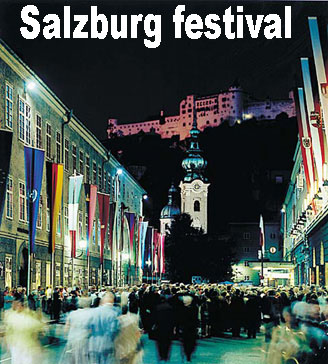
Salzburg International Festival
Salzburg, Austria

I’d like to say that I planned months in advance and had prime seats waiting for me at Salzburg’s month-long “Festspiele” International Festival of music, but the truth is that I staggered into town clueless and unprepared on the first Friday of performances. However, this bumbling arrival had little impact on the amount of entertainment that I managed to glean from the festival over the week I spent in Salzburg.


Narrow passageways


Narrow connecting tunnels


Once I was settled in one of the last beds available in town (actually, I was outside Salzburg, on a cot at a campsite, in a semi-permanent tent), I dove into the teeth of the festival site in Old City. Salzburg’s Old City streets are narrow, cozy and inviting. They have carefully preserved the motif and décor from hundreds of years ago, going as far as to force the dreaded McDonald’s to conform so closely to its modest street sign and building regulations that you could walk by three times before you notice the restaurant. Simply exploring the maze of streets in the Old City can keep you occupied for hours. The haphazardly laid streets are often interconnected by scattered archways and what appeared to be small tunnels that burrow right through otherwise uninterrupted rows of buildings. These tunneled alley-ways are so small and inconspicuous that at first glance you would assume that they were someone’s private garage or an entrance to an apartment building until you squint through to the other side and see crowds of people streaming down yet another street. Sometimes the tunnels open up into huge enclosed courtyards with cafes, businesses and even little playgrounds. The tunnels themselves have small outcroppings that house display windows, tiny shops and vaguely marked stairways which lead down into restaurants and pubs that, judging from the rock-faced walls, appear to have been carved into the ground out of a solid stone foundation.

The Festspiele boasts outstanding performances of every music genre from classical to contemporary by ensembles from all over Europe. Seats to some of the featured performances are as coveted as the first level at the Super Bowl. While attending the big ticket performances requires that you plunk down a bag of money up to nine months in advance or be very well connected in political or royal circles, the best shows are arguably on the streets. Free preview performances by some of the featured troupes and a fantastic variety of street performers and musical groups jostle for position and keep things interesting for the less privileged masses and unprepared tourists.


Street performer


Street performer


During peak festival times, a walk from one end of the Old City to the other can take all evening due to the jam-packed state of the streets. Performers are so plentiful and do such a brisk business that the crowds from each act often merge together into a huge impregnable sea of people. While a scene like this might normally be considered a nuisance, the good natured, tranquil atmosphere of the of the festival attendees makes being hemmed in by thousands of people almost a joy. If people watching gives you any level of satisfaction, prepare to be agog and riveted by the endless offerings that accompany European festivals of this size. The glimpses of the comings and goings of Austria’s president, VIPs and rich and famous will keep you entertained and euphoric for hours every evening.

Even last-minute attendees with more discriminating tastes can find gratification by such surprise gems as free performances by the fantastically talented New English Orchestra in beautiful, ancient St Peter’s church. It was during my indiscriminate exploration of the Old City streets that I chanced upon a New English Orchestra (NEO) PR person forcing pamphlets on passersby. I took a pamphlet as he promised me that the concert would be the best thing that I saw in Salzburg. As bold as this statement seemed at the time, I am happy to report that it was not an exaggeration by any measure. The two free concerts given by the NEO were exquisite, their mastery making me completely forget that I am usually not a fan of classical and religious music.


Trick fountains


Trick fountains at Hellbrunn Palace


If you suddenly find yourself in love with Salzburg and are craving more information about the city, their 48 hour “tourist card” is one of the best all-in-one city visitor passes in Europe. The card affords one free or greatly reduced entrance into countless museums, historic sights and access to all public transport. You will need every waking second of the 48 hours to squash in visits to sights like the former residence of Mozart that includes a sound and film collection, the Salzburg Cathedral, the massive Hohensalzburg Fortress, the Hellbrunn Palace and trick fountains, the Salzburg Museum of Natural History, the 500 year old Stiegl’s Brauwelt brewery and all of the “Sound of Music” related sights.

After a few nights of subsisting on street vendor food for dinner, I decided that a meal at an authentic Austrian restaurant was in order. I secured directions to the Wiesenhof Gasthof, which consisted of a moderate bus ride out if the city center and a brief, mildly confusing walk through a residential neighborhood. I considered this a necessary evil as I was craving a break from the shoulder-to-shoulder tourist crowd situation back in the Old City, if only for a few hours. The Weiserhof Gasthof only has seven tables that seat eight people each, so your meal effectively requires encounters with the natives. I ordered the sautéed potatoes with white sausage and onions, topped off by a fried egg and floating in a shallow pool of grease. At first glance it seemed to be a bit of a cardiac annihilator, but I quickly concluded that it was probably far short of the average amount of grease I consumed per day in the States, so I dug in eagerly and enjoyed the meal with a clear conscience.

Unfortunately, due to the myriad of waiting adventures in a dozen other countries throughout Europe and the condition of my back after a week on the campsite cot, I was not able to stay in Salzburg as long as I would have liked. However, leaving town with a taste for more probably heightened my all around impression of the Festspiele and made the memories more cherished.

Tickets and all reasonably comfortable beds for the 2004 Festspiele (July 24th through August 31st) are already being swept up at a blistering pace. For more information and a complete listing of the scheduled performances go to www.salzburgfestival.at.