


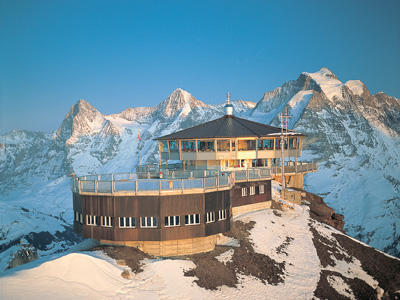

Jungfrau, Switzerland
 |
| Lauterbrunnen Valley |
The Bernese Orberland region of central Switzerland holds some of the most awesome scenery in all of Europe. I start my journey in Lauterbrunnen, just south of Interlaken, where a triple-peaked ridge rises out of an idyllic valley. These giants: the Eiger (13,025 ft) the Monch (13,448 ft) and Jungfrau (13,642 ft) are accessible via the Jungrau Railway, an extraordinary rack system that took 16 years to construct, and has been carrying passengers Europe’s highest train station since 1912.
The modern cogwheel trains leave every half hour and lumber up the mountain, making several stops at stations higher up, and occasionally pausing to let a descending train pass. The orange and yellow coaches are basic. You will not find a bar car with Cary Grant sipping a Manhattan in a white dinner jacket, but you will find super-size windows that slide open wide enough to hang out with your camera and feel the alpine air and sunshine on your face. Reels of scenery stream by and the constant clickety-clack of the tooth and groove rack rail system below the belly of the train is hypnotizing. Even the erratic hollow clang of cowbells in the distance can’t disturb the lullaby.
Above the fir tree hills, Lauterbrunnen Valley comes into view. This U-shaped valley is the world’s deepest and is the very definition of Alpine scenery. The valley floor spreads between majestic cliffs that soar to 3,200 feet. From cracks and crevices in the rock gush waterfalls (72 in all), including Staubbach falls, Switzerland’s highest, which pours down almost 1,000 feet. Wooden houses sit on a lush green carpet and look like monopoly pieces beneath the mammoth surrounds. I snap photos knowing this scene will be impossible to truly capture.
 |
| An extensive railway system pulls riders to the heights of Europe |
Here, I change trains to another cogwheel coach that will take me the rest of the way up, through an impressive tunnel 7,789 yards long blasted out of the rock. The Jungfrau Railway now carries up to 4,000 visitors per day through the center of Eiger and Monch. This leg of the journey moves quickly, and the change in pitch pushes me back in my seat at certain points. Stops are made at two other stations within the tunnel where I de-train and take in the noticeably colder temperatures, and views from windows built right into the mountainside.
At the top, it is again the scenery that is the draw. On a clear day, France and Germany are visible, as well as part of the Aletsch Glacier, the longest in the Alps. Today, the snowy views are certainly beautiful but I can’t see France or Germany. There is no color, no trees or flowers, and the sky has turned as white as the snow. The rest of the station is overrun with tourists, souvenir shops, a cafeteria-style restaurant, and an underground tunnel misnamed the “ice palace”. One cool (no pun intended) attraction is the post-office that will cancel envelops with a “Top of Europe” postmark and mail them. I take a few photos from the outdoor observation deck, and mail myself a postcard before boarding an outbound train.
It is said the journey is more important than the destination, and this is no exception. I happily begin the leisurely descent down to reality, hanging out the window, listening to the cowbells, and searching the flower filled meadows for the young girl in the blue dress who has captivated me for so long.

0 comments:
Post a Comment