


 |
| Waterfront Tavernas on Poros Island |
Huddled in my jacket and leaning into the wind, I wandered along the waterfront of Poros Island. My mood matched the dismal weather. After a rough sea crossing from Pireaus earlier in the day, my equilibrium was stabilising and my stomach was settling. I had planned to sail to more distant islands on this voyage, but seasickness had urged me to seek dry land, to await more suitable conditions.
This was my second day in Greece – my first Greek island – and I was yet to glimpse a shred of sunshine. Where was the fabled crystalline light, the dazzling blues and whites? Where were the bustling waterfront tavernas described so vividly in holiday brochures? Everything was so quiet, layered in grey. Would the entire five weeks of my holiday be blighted with weather such as this?
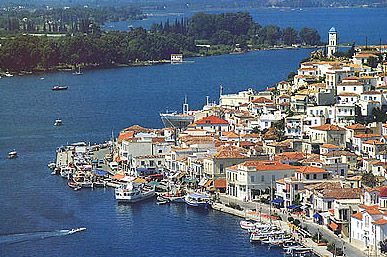
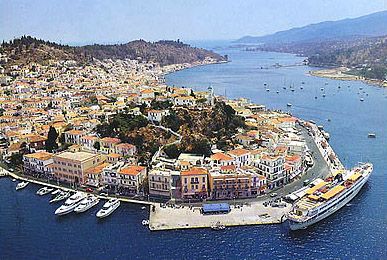
Pausing at the water's edge, I glanced at my surroundings. The lavishly carved harbour hugged a hillside of whitewashed dwellings, haphazardly terraced on top of each other, pressed into rocky outcrops and some seemingly overhanging the water. A clocktower crowned the hill, resplendent with a blue and white Greek flag whipping in the wind. A narrow neck of sea, divided island and mainland appeared to be almost within throwing distance. Despite the gloomy weather, I could not fault the setting.
I watched the activity on the water before me. Little ferry boats rocked eagerly at the wharf's edge awaiting passengers for the five-minute crossing to the mainland. Across the inky passage, tavernas and shops of the village of Galatas edged the shoreline, dwarfed by a backdrop of mountains and peaks obscured by low cloud. A large car ferry was returning, churning across the channel, wind flouncing spray across her bow. The wind was brisk and fitful, swirling sounds and scents, the tang of salt and the distinctive damp threat of rain. When the aroma of sauteing garlic drifted by, my rumbling hunger sent me fossicking for food.
After ambling ten minutes or so, I discovered a narrow taverna situated on the southern end of the waterfront. I had been advised from experienced travellers to seek the smaller, more traditional establishments. "Eat where the locals eat and you can't go wrong."
Tentatively, I peered into the aromatic interior. A small, blonde lady in the kitchen at the rear caught my eye and smiled.
"Ella ella," she beckoned and I ventured in.
"Pos se lene?" she queried, linking an arm through mine. I shrugged and we both laughed. After several attempts at communication, we finally exchanged names. Voula led me into the steamy warmth of her kitchen where cooking for the evening was in progress. She made two coffees and produced a tray of walnut cake dripping with honey. I felt my despondency and disappointment of the day evaporating. Her English was limited and my Greek non-existent, but after much gesturing and chattering, it was agreed that I would return later for a meal.
That evening I ventured out on the edge of a storm. Rugged up in coat, scarf and gloves, I scurried along the shadowy foreshore with the wind at my heels. The night was bitingly cold, icy gusts scudding across the straits from snow capped mountains. The whining wind echoed the aloneness I was feeling. Most tavernas along the dimly lit waterfront were still shutdown for winter, a bleak scene of hibernation and desertion. In the distance I glimpsed Voula's taverna, light spilling from the windows patterning squares on the dark pavement. I detected the faint drift of music and my spirits lifted. Struggling with the wind, I manoeuvred through the front door to where the warm smoky haze, tantalising cooking aromas and deafening volume of Greek music embraced me like an old friend.
With interest, the clientele turned to observe the newcomer. At this time of the year tourists were not a common sight and most did not venture far from their hotel during weather such as this. I was immediately welcomed by Kosta, the waiter, who beamingly led me to a small table and offered me a complimentary glass of ouzo. I expressed my aversion to ouzo and wondered if he could suggest a white wine. "Ah, have you tried retsina?" He kissed his fingertips. "It is good. It is the krasi of Greece. I get you retsina."
Feeling a little conspicuous, I glanced around at the interior of this minuscule taverna. Historic photos of Poros waterfront peered down from high walls. Baskets and jugs and artificial flowers lined sagging shelves. Lace cafe-style curtains looped across the front windows. Near the door, wall hooks groaned under the weight of heavy winter coats.
 |
| View of mainland Greece and the village of Galatas |

Nearby, clustered incongruously at a small table, sat three fishermen, knee high in gum boots, drinks and cigarettes in hand. Faces leathered and etched by the elements, they studied me with open curiosity. I nodded, smiled and received a slight tilt of their glasses. A young couple at another table were intent only with each other. An elderly gentleman dining alone nodded courteously at me. Nearby, a table of three young men, dark eyed, brooding babes, returned my subtle surveillance. I dragged my gaze away from the embodiment of Enrique Iglesias and concentrated on the historic wall photos.
Returning with a small anodised jug of retsina, two glasses and a basket of warm bread, Kosta poured the wine and raised his glass to mine. "Yamas," he toasted, joining me for my first taste of the resinated wine of Greece.
The astringency washed through my mouth and startled my palette. I ventured another sip and was rewarded with the faint taste sensation of pine. If one could drink the fragrance of a pine forest, then this must be the taste. Did some ancient memory stir my consciousness? It seemed a long forgotten experience, a rediscovered pleasure. In another age, long ago, had I once known this taste of sea and pine and salty air?
Oblivious to my musing and analysis of this unusual krasi, Kosta explained that a written menu was not available because the fare changed daily. He began to describe the delicacies available that evening. Then he changed his mind.
"Ella! Come! You must see for yourself. There is much food. You will want to try everything!"
Taking my arm he led me to the kitchen where I succumbed to Voula's effusive welcome. She squeezed me and playfully patted my face. "Orea, orea! Beautiful, beautiful!" Years later, Voula still ritually bestows me with this compliment and each time, I wallow shamelessly in the attention. Cheerfully she showed me the dishes, constantly chattering in Greek, pausing to ask personal questions, while Kosta with the air of a foreign diplomat, managed to maintain the flow of conversation with his questionable translations. So began my fascinating association with this traditional Greek taverna, my appreciation of retsina and my enduring friendship with Voula.
 |
| Fishermens' wharf area on Poros Island |
After several nights at Voula's taverna, stilted conversations were initiated and soon questions were fired at me. I discovered that most Greeks are naturally and inoffensively curious about strangers and have a proclivity for asking personal questions – Are you married? Have you been to Greece before? Do you like Poros? Where are you staying? And how much do you pay? (Ah, but my cousin could make a better price for you). Are you married perhaps? Why do you come in such bad weather? Do you have a boyfriend perhaps? Where are you from? Ahh Australia! Invariably, a flicker of understanding appeared as though this fact alone explained many of my eccentricities.
The evening clientele consisted mostly of locals, fishermen, workers who sat around drinking ouzo, Metaxa brandy or retsina and partaking of mezedes (nibbles) before heading home. Some people ate more than mezedes – stuffed calamari, yemista (stuffed vegetables), patates tiginites (chips), baked lamb chops or briami (baked vegetables) spread out before them and left to cool, as they chatted, smoked, drank and quite often, danced.
A true Greek likes to eat his food at room temperature and prefers to linger over a meal savouring each morsel. I was often tactfully reminded how quickly I ate. When I explained that I liked to eat my food very hot, I am not sure if this idiosyncrasy was fully appreciated.
Many evenings, Apostolos, a wiry, ancient gentleman claimed a particular table in one corner of the taverna. Through a cloud of cigarette smoke, he observed the world, eyes hooded, a glass of ouzo in hand, a plate of cold food at his elbow. Without comment, he listened to conversations – the size of catches by the fishermen, the stories of bravado from young men, the chortling and chatter from the kitchen, the games of children, the whispers and secret touches of new lovers. Perhaps he was reliving conversations and memories from the archives of his lifetime.
Apostolos also liked to sing. At any unlikely moment, he would rise, hand at heart, the other clutching his ouzo, chin uplifted, and in quavering baritone, he would sing some forlorn rendition of a long ago favourite. Someone would quickly turn down the volume on the stereo and the room would hush, absorbing the rich timbre of his voice. His gaze often burned across the room in my direction and if I dared to make eye contact, he would smile tragically, eyes locked with mine until the devastating finalé of his song.
Much clapping and encouragement always followed. With the polish of any great performer, he accepted these accolades with a flourishing bow before returning to his reverie. His spontaneous performances were the highlight of any evening. Indeed, some evenings when Apostolos was progressively fortified by ouzo, we were often blessed with several performances.
 |
| Sunset in March over Saronic Gulf from my hotel on Poros Island |
My first jaunt along this area honed my survival instincts and pumped adrenalin through my veins – a kneejerk legacy from my other world of deadlocks and crime saturation. The area was always dark and deserted, punctuated by the whining wind and water slapping against the wharf. The darkened outlines of fishing boats and piles of net on the wharf conjured a threatening scene in my imagination. I once commented to a companion of my concerns and the possibility of undesirables lurking in the shadows. Yannis, towering above me, smiled indulgently and reassured me, "Do not worry koukla, there are no gangsters on Poros."
The days blurred into weeks and this Greek side of March was showing me that every day is a celebration, not the celebration that comes with intoxication but that which comes with ability of embracing each moment. At first I moved in a world of strangers, a stranger in their land. As time passed, I was drawn into their lives, accepted as a friend and encouraged to share their moments. The weather no longer concerned me. Rather than acquiring a suntan during my time in Greece, an intangible warmth was silking my skin. A warmth I recalled from long ago – a sense that all is well with one's world – a world to which I have since returned as often as I can.

0 comments:
Post a Comment