


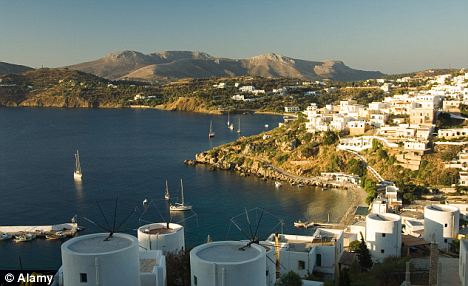


Sailing the Dodecanesee
Kos to Leros, Greek Islands, Greece
I need to start this story around Christmas of 2001, when a tiny seed of a travel idea germinated in my head. I’d always wanted to go to Greece, particularly the Greek isles. I’d read that the best way to see the islands was to sail them in your own boat. So I put some research in what it would take to achieve.
The short answer is two qualified skippers and a charter company. The long answer is twelve months of hard work, lessons in coastal navigation and a fair amount of chutzpah. There are several ways to charter a yacht, most involving a professional skipper, but the quintessential way to do it is what’s called a “bareboat” charter.
In a bareboat you rent a boat from the charter company for a period of one to two weeks and are responsible for getting from point A to point B by yourself, hopefully without crashing into anything at point C. Obviously, this requires a fair amount of knowledge. Hence, the aforementioned twelve months’ hard work and lessons in coastal navigation.
Once I had worked out the possibility, I needed some help. I found five friends interested in joining me on a cruise in the Greek islands. I went off and learnt to sail.
I’d sailed before but never really spent much time on the water. During a trip to Sydney at Christmas, I tried a bit of an exploratory four-day course and discovered I really did like it. After that I put some time in on the Solent in England and when I was transferred to Boston, I joined a yacht club and started sailing enthusiastically. Earlier this year I picked up my “Coastal Skippers” qualification with the Haslar sea school in Gosport.
Twelve months later we set out on our journey. We picked up the yacht from a marina on Kos on a Friday afternoon and planned to head north into the Dodecanese. The rough itinerary was to go north from Kos to Kalymnos and then up past Leros to Patmos, Lipsi and Arki. As fate would have it, we didn’t quite make it, but we did go as far as the north of Leros.
Checkout for the yacht was relatively easy and after a few corrections (a missing fire extinguisher and some faulty instrumentation), our trusty steed, Isis, an Oceanis 381, was ready to go. In theory we might have made Kalymnos that evening but we decided to stay in Kos so we could have a more leisurely start to the holiday the next morning.
Much had been said by my compatriots about the beauty of the Greek isles, the friendliness of the Greek people and the blandness of Greek food. It was with some trepidation, therefore, that we selected the restaurant for the evening.
After a 20-minute walk along the seafront, we found a little restaurant with tables on the water’s edge, and we sat down to dinner. Erring on the side of caution, I selected a fairly neutral chicken souvlaki and was extremely pleased when it turned out to be not only adequate, but very good. In fact, as the murmurs of appreciation around the table showed, the food was excellent. This proved to be a good omen. In fact, throughout our trip the food was so good that I think we put to bed the myth of bland Greek cuisine.
Arising relatively early the next morning, we put to sea in a very uncharacteristic rain storm and loitered off Kos waiting for it to pass. The departure from Kos is worth noting. From the Kos marina, you exit to the east, directly towards the imposing Turkish coastline and the port of Bodrum. As you turn northward towards Kalymnos, you have to round the shoals at Ak Amargosa and keep a watchful eye open for the regular Hydrofoils that zip up and down the coast at thirty knots. I was delighted to spot a bill fish turning back flips off our port beam at this point and took it as good omen for the rest of the trip.
Once clear of the northeast tip of Kos, we raised the sails and turned west towards Kalymnos and the Pserimos. Pserimos is a tiny island between Kalymnos and Kos. It is noted as a stopover point for daytrippers from both islands. In a steady fifteen knots of breeze from the north, we made a respectable five knots and pulled into Nisos Plati about two hours after leaving Kos.
Just to the west of Pserimos is the islet of Nisos Plati, a tiny island with a sheltered anchorage on its northeast side. This was my first “port of call”, so I was nervous. I snuck into the bay under motor at minimum speed. We had no problems anchoring. Soon we were riding off the “hook” in about five meters of crystal-clear, blue-green water.
After a suitable pause to make sure we weren’t drifting at anchor, Ian, my co-skipper, dove over the railings into the sea and I followed him a couple of minutes later. Swimming off the back of yacht is one of the most delightful experiences and makes trudging up and down the beach seem a little dull.
The water off Nisos Plati was clear and green and the fish were bold and inquisitive. After a bit of swim and some lunch, we lay down in the sun for a nap and this set the pace for the rest of the holiday. One of the problems with being on a boat, however, is that they don’t necessarily stay where you put them. When we arose to contemplate our next step, we discovered the boat had drifted considerably. We started the motor, recovered our puny little CQR bower anchor and I vowed never to trust it again as we headed off towards Kalymnos.
The Greek Waters Pilot on board described Kalymnos as a “great craggy lump of rock” that “imparts a feeling of prehistoric permanence.” This certainly rings true. From Pserimos we headed into the main port of Pothia hoping to get a berth in the Kalymnos marina.
As we pulled into the harbour some two hours later, I looked over the large yellow dredging machine parked where the charts indicated a marina and recalled the words of the charter operator back in Kos. “They’ve been trying to build a marina in Kalymnos for seven years now, but they just can’t get it finished.” Resigning myself to an early introduction to the joys of “Mediterranean mooring,” we headed up into the town itself to moor against the quay.
Mediterranean mooring is a very practical way of parking a boat but not practiced much anywhere outside the Mediterranean. It is viewed with some trepidation by most foreign skippers. The process involves dropping anchor a couple of boat lengths off the quay and backing down to moor “stern-to.” Given that your average sailing vessel behaves like a very quiet but single-minded, five-ton shopping trolley, this prospect becomes less than simple.
Still, the actual mooring proved to be not too difficult. We were assisted by a very nice Dutch crew whose boat we moored too since the quay was full. The whole process was relatively painless although we were alarmed to see soldiers in fatigues and a full marching band awaiting us on the quay. It turned out to be a local festival in Pothia – an auspicious arrival. The departure was going to be less favourable, though.
With the boat parked and one day of sailing under our belt, we headed off in search of sustenance and entertainment. The first was provided by a lively local restaurant owner who touted us with good manners. Most of the crew opted for seafood, but in an uncharacteristic poor pick, I had the pork souvlaki and spent most of the evening green with envy.
The restaurant also featured live music with a keyboard accompanied by a reborn Greek, Eric Clapton on Bouzouki and vocals. We liked the bouzouki player so much we embarrassed him a little with a round of applause but perhaps not so much as when his mobile phone rang in the middle of a piece.
To our delight, we discovered that the local festival included an open-air concert in the main square. I sat for about an hour and listened entranced along with a couple of hundred foot-tapping locals. The stage was set in the corner of the square and against the black backdrop of the vertical crags which surround Pothia on three sides. High above the players, suspended against the night sky, was a brightly lit monastery and the music floated up towards the monks who must have thought it an epiphany.
We arose early and prepared to set off (etiquette demanding that the last arriving boat leaves first). After a bit of scrounging around Helen and Viet-Anh, we managed to provision the boat before raising the anchor and heading off. Raising the anchor wasn’t as easy as we had anticipated because in some mysterious Gordian transformation, another boat’s anchor chain had ridden over ours. It took the combined efforts of Simon and Ian to free us. In the process we were dragged out of position and had to do some emergency fending to keep us off the other boats moored at the quay. But we were free and we headed out to sea.
From Pothia we turned south and west around the bottom of Kalymnos, up north heading for an anchorage in Emborios. Emborios was a completely different from Pothia, but no less enjoyable. After about three hours sailing up the coast, we turned into the east and negotiated the channel into Emborios.
Emborios is a tiny bay with a cluster of tavernas and very little else to recommend it other than a beautiful beach and (at the time) oodles of bright sunshine. The tavernas are described in the Greek Pilot as “yachty friendly” and have even gone to the extent of laying out moorings for visitors.
Another quick swim was mandated. The crew soon demanded a trip to the beach, so we brought out the inflatable, fired up the outboard and zipped into the shore. Afterwards we bought some supplies at the local store and headed back to Isis. We were able to locate a couple of hand lines so that the more carnivorous of the crew could indulge their primal habits by fishing off the back of the boat.
That evening we thought it only fair to visit the restaurant whose name was emblazoned on the mooring we had captured. Since we weren’t being charged a mooring fee, it seemed only right to repay the good will in trade.
We were introduced to the Greek taverna custom of the kitchen inspection. Since the standard menu of a Greek restaurant can be limited, they like to supplant it with fresh seafood, displayed in the kitchen. Like excited school children, we trooped into the kitchen behind the owner and poked and prodded his fish, examined his prawns and tried to ignore the crayfish that he was desperately hawking. In a moment of weakness, I succumbed and ordered the crayfish.
After dinner we secured a bottle of wine from the restaurant and retired to the boat. Getting into the inflatable proved a bit of a challenge for the crew. We nearly lost one over the side during a badly timed lunge to sit down. Back on Isis we opened the wine, lay on the deck, stared up at the Milky Way and talked about how far away work and the rest of the world seemed.
The next morning we didn’t get out of the anchorage and on the water till about noon. The wind was the reliable fifteen knot northwest Meltemi. We beat away from Kalymnos and up the coast of Leros. We covered a good twenty nautical miles (36km) and pulled into Ormos Partheni at about four o’clock.
Ormos Partheni was in much the same pattern as Emborios, only less populated. It had been a large military base and so sported a full size airstrip, a small army contingent and a considerable boatyard. There were no laid moorings available, however. We were forced to anchor in the north east end of the bay.
A few yachts were already swinging at anchor and our first attempt with the tiny CQR anchor convinced me it was untrustworthy. Not wanting to spend a sleepless night wondering if the scraping sound on the hull was just the dinghy riding up and down, or a neighbouring yacht grinding its way down our sides, I decided on a second anchor. Isis thus secured, a couple of us went on a scouting party to see if we could locate a suitable spot for dinner.
Our first port of call was the boatyard and we were extremely lucky to bump into a retired English marine engineer putting his boat to bed for the season. He told us there was only one restaurant in the surrounding ten miles where one could eat. If we followed his directions, we could meet him there.
We returned to the boat and everyone prepared to go ashore for dinner. We had to do two trips with the dinghy and on the last of these we ran into a small problem. I had neglected to remember that outboard engines run on petrol and had consequently failed to refill it since we had left Kos. Luckily I had remembered to bring the oars in case of emergency and there was some enthusiastic rowing later that evening.
From our landing point ashore we wound our way for 15 minutes up and over a hill and down into the local taverna. It turned out that the taverna was situated on a lovely open beach with tranquil blue waters. There was some threatening muttering amongst the crew about choice of anchorages, but I was rescued from certain bodily harm by my co-skipper who pointed out that it was exposed to the northwest and would be uncomfortable as an overnight anchorage.
We settled down for another delightful evening meal. I spotted my nautical engineering friend and his wife in a corner. He revealed that for the past seven years he and his wife summered on Kalymnos and then headed back to Britain for winter. Later I discerned a certain lethargy about the table and enquired as to whether or not our itinerary might be a bit too ambitious. We had planned to go further north in the morning, heading for the smaller and more remote isles of Lipsi and Arki. That would have left us further from our base in Kos and would almost certainly have meant two days of hard sailing to get back.
The relief around the table was evident. It was decided that we try a less strenuous course for the next few days. We returned via the overland track and with the assistance of Simon and Karen, I rowed the dinghy out to Isis and refilled the outboard. Everyone slept well that night.
We arose early, determined to be a bit more organised. We retrieved both our anchors. The Danforth had stood us in good stead and I could swear we hadn’t moved more than a couple of inches all night. We had a quick stop just around the corner at Arkhangelos to move the dinghy onboard from its position on a line behind the boat.
We turned south with the winds and started our run down to the next stop at the port of Lakki. That day was the best sailing conditions of the whole trip. Running before the wind we averaged about six knots down the coast to Lakki. Nearly everyone had a go of steering and most of the crew were able to gybe the boat by the end of that stretch.
In fact, we were so absorbed by the sailing and made such good time that we nearly sailed straight past Lakki and off into the sunset. At about twelve o’clock we turned into the entrance to Lakki and headed for the marina. We had chosen Lakki the night before because of its marina and the fact that we had run out of fresh water on board. While the boys were content with salt water ablutions, the female crew was suggesting a mutiny if we didn’t rectify the situation soon.
Lakki is an odd little place giving the impression of being much larger than it actually is. The town is the main ferry port for Leros and sports a quite sizable seafront and boardwalk, but doesn’t extend more than a couple of streets beyond this. One of the reasons is that the island was occupied by the Italians who invested heavily in Lakki and attempted to transform it into a kind of Riviera. As the Greek Pilot suggests, Lakki “has the feel of a mock-up for a film about Mussolini or any Second World War movie set in Italy.” Leros itself has suffered a bit of a reputation as being a haven for lunatics (which it was at one stage), and much greener and lusher than the surrounding isles.
Determined not to make a meal of the mooring again, Ian and I went over the plan in detail as we motored into Lakki. It turned out to be not much of a problem because the marina was well laid out and staffed by a large friendly man named, Nikos. As we idled in towards the quay, he waved us over to a particular spot and then passed us a “lazy line” as we backed in. The lazy line is a much more civilised approach to Mediterranean mooring and consists of laid anchor chains with lines running to the quay. You do not need to drop anchor. Simply back down onto the quay, pick up the line and cleat it off on your bow.
Ian and I headed off to the Port police office to complete the formalities and the female portion of the crew disappeared into the shower block with what sounded suspiciously like a stampede. After checking in with the Port Police, we returned to the marina office, paid our fees (about twenty-three euros) and organised for some water to be delivered to the quay. When we asked Nikos if he could recommend somewhere for lunch, he smiled broadly, gestured to the extremely large restaurant attached to the marina office and said, “Here.”
We took him up on his offer and over an oven-cooked haunch of lamb with saffron, we discussed plans for the evening. Someone would have to wait with the boat for our delivery of water. Aside from that, everyone seemed in favour of doing a little exploring. I elected to stay with the boat since I was pretty tired and didn’t fancy walking about during the heat of the day.
While waiting for the waterman, I was able to contemplate the little brown suicidal doggy that seemed to be attached to the marina. This energetic little pup would lie in wait at the side of the marina and then sprint out at each car, van or motorbike that thundered by. It wasn’t always clear if he was trying to chase the cars or jump in front of them, but judging by the number that failed to squish him, he was an expert in near-car experiences.
After everyone returned to the boat, we went to a nearby taverna where we had the only disappointing meal of our entire trip. It did provide some light amusement, though, in the form of a cement track with a kind of watered down go cart for pre-school-age, budding Greek racers.
In any case we headed off after dinner and retired to the boat once again for post-dinner drinks. The stars weren’t bright but good wine and the proximity of ice cream supplies and hot water, made up for any lack of rural charm.
The next morning presented something of a sailing challenge. We could have returned down the west coast of Kalymnos, the way we had come, but we wanted to detour to the east, towards the coast of Turkey. The channel between Leros and Kalymnos is only about three hundred meters wide at some points. In antiquity, the two islands were known as one Lero-Kalymno. We negotiated the straights off Xerokambos without much difficulty, and headed southeast down the coast of Kalymnos.
The sailing was again delightful and we ran before a fifteen-to-eighteen knot wind all the way to Vathi. About three miles off the coast at Ormos Palionisou, a Greek frigate sat drifting slowly south. We had seen Greek warships before and generally had no troubles, but Navies have a funny way of not obeying the normal rules of the sea. It’s best to give them a wide berth. We were just doing this when another warship came bearing down on us from directly ahead in the south. Doing a good thirty knots and kicking up frothing white, the patrol boat could easily have run us down. There was some frantic course changing to give him a wide berth.
Imagine the consternation when a third warship appeared on the scene and started bearing down on us at speed, again from the south. It was at this point that someone quite appropriately put the James Bond sound track on the stereo. Seeing that the coast of Turkey was less than twenty miles away to the east, there was every chance of us being involved in an international incident. This third warship proceeded past us and headed north up the coast. I suspect it was Turkish and the Greek frigate had been waiting for a traditional game of cat-and-mouse. We were glad to be rid of both of them.
About half an hour later we turned slightly west and headed into Vathi – a beautiful harbour with a dramatic entrance. Around it the hills rise in sheer cliffs some three or four hundred metres high. The entrance to the harbour is only twenty or thirty metres wide. As we motored in, we found a pair of large Greek warships parked there. A local friend had told me that a new taverna had been built in Vathi by some aspiring businessman. The current taverna operators had decided that this might be more competition than they would enjoy and dynamited the taverna into the ocean. The presence of the warships lent credence to the taverna-dynamiting story.
The harbour at Vathi is tiny with barely room on the extended quay for more than seven or eight yachts and only a boat length or two in which to turn. The wind gusts down from the hills and through the harbour mouth. I announced we were going to moor bows-to and not stern-to. We had set up for a stern-to approach and bows-to meant moving the lines and fenders and laying out the spare anchor and its forty feet of chain. We’d also never done it before.
My decision proved to be a good one and we handled the mooring with precision and aplomb that made us looked like seasoned veterans. This was particularly useful because later on we were able to sit smugly on the aft deck of Isis and watch a number of ham-fisted attempts at mooring by some late-comers.
Mediterranean mooring is quite a spectator sport and as one of the crew commented, much more exciting than daytime television. Once you are safely in and secured, you can sit back and watch everyone else jostle for position. An Austrian crew next to us had more than four attempts to get onto the quay and there was some fender crunching action further up the line when an Italian boat came in.
Since we were safely moored, we lent a helping hand to some of the new arrivals and then ducked off for the traditional afternoon swim. Vathi has a good little swimming area on the end of the quay next to the rocks. Ian and Karen had a go later at jumping from these in the manner of the local kids.
A walk round Vathi showed that although the entrance is narrow and rocky, it soon opens up into a broad-hipped, fertile little valley. The soil is rich and earthy-red and supports citrus plantations and even the odd vineyard. From the cliffs around the harbour’s entrance, you get a magnificent view up the valley at sunset.
Dinner that night was at the Harbour Taverna and everyone elected to try the fresh fish. The waitress brought a platter to our table and we selected our own specimen to go on the grill. Washed down with local wine and Mythos beer, it was as good as any meal we had had and capped by chocolate ice-cream for dessert.
That night, sitting on the back of the boat, it was difficult to imagine being back at work behind a desk. After a while I took my glass of wine and sat on the end of the pier and looked at the lights glittering on the shores of Turkey. Sitting there listening to the chorus of cicadas in the hills, I could easily visualize sailing as something I could do for longer than a week.
The week had been filled with so much sensuous experience that I felt quite drained. Mooring dramas in Pothia, the pulse of bouzouki music in the night, the peace and quiet of Emborios, the stars at Ormos Partheni, the run down the coast to Lakki, the drama of the Vathi harbour and the cold green fingers of the Aegean as you dive off the back of the boat all clung in my mind as bright, tactile memories. I was going to miss my Greek paradise quite a lot.
The next morning we headed out of Vathi quite late and stopped off at Pserimos one last time before heading back to Kos. Docking in a twenty-five knot cross wind was a bit of an adventure but we were ably assisted by the marina crew and got ashore without too much fuss.
I was sad to see Isis go. I could have spent a lot longer exploring the waters of Greece. I’m not sure if I’ll be back next year. This holiday has opened up some interesting alternatives. I’m told that Croatia is a beautiful place to sail. So is Turkey, as well as the Caribbean. There’s the Maldives, Mauritius and Thailand. Australia has the Whitsunday Islands. There’s Tonga, Tahiti and the Bahamas. I’m going to have to give this some thought – quite a lot of thought, actually.

0 comments:
Post a Comment