




As if on queue, elderly Greek gentlemen are drowsily dragging themselves to the Cafe Platanos in Leros. The afternoon nap is over and it’s time to get on with the day.
Leros is one of the Dodecanese islands, with a population of only 8000. This particular cafe, named after the capital Platanos, lies on the central square, close to the town hall, and is frequented by tourists as well. A Danish couple are already here and a Norwegian couple are just arriving. Married people, of middle age and Scandinavian origin, are so common in Leros that single tourists are looked upon as outsiders.
Platanos has gradually merged with two neighbouring villages, Pandeli and Agia Marina, high up in the hills. The other two are situated down by the sea, one on either side. While cars struggle uphill from Agia Marina and Pandeli, they afterwards sigh with relief when coasting down on the opposite side. A mirror prevents them from colliding in a sharp, narrow bend on the actual square.

A Fuming Lady
The back door of a white car, just pulling up in front of the town hall, is thrust open by an older, exasperated lady. Dressed in a white blouse and dark skirt, she rushes across the square, fuming and raging, so agitated that even the men in the cafe raise their eyes. Although the square slopes upwards, the elderly woman starts running, as if determined to run all the way up to the castle, Kastro, perched 300 steps above.
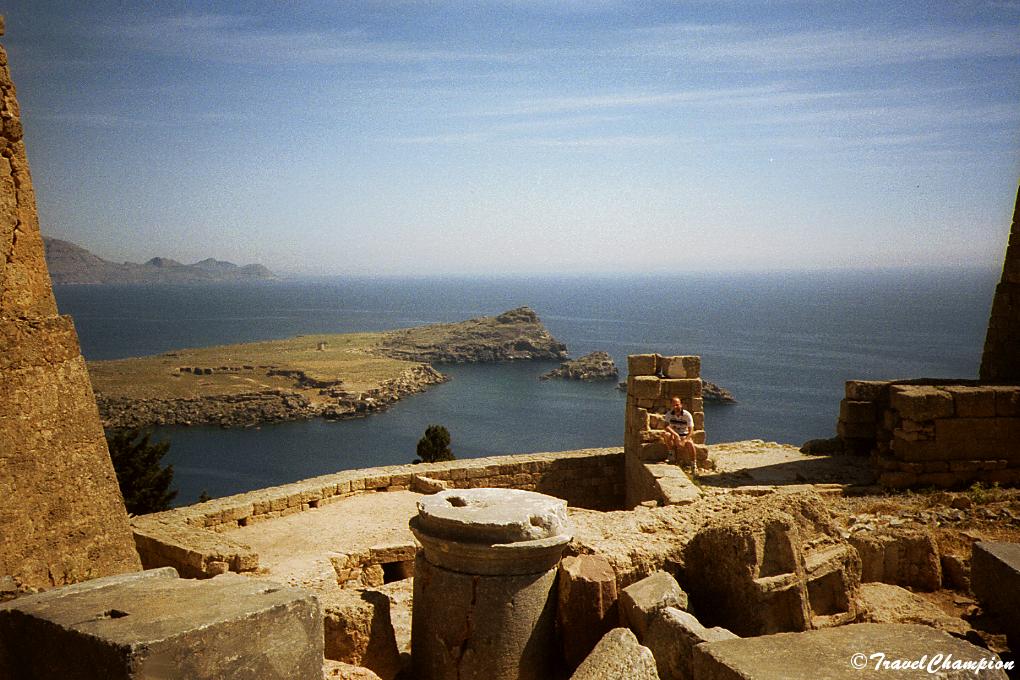
The woman can, however, look forward to enjoying a panoramic view, but to reach the top in the afternoon heat, she’ll have to slow down. Her business may possibly be to seek comfort and counsel in the Panagia Church inside the walls of the castle. The well-preserved fortress is the work of the Knights of St. John whom the woman need not fear; they left Leros in 1523.
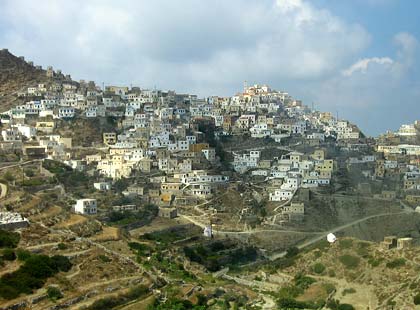
First of all, she’ll probably check whether her white car is still waiting. She should then take time to admire the beautiful town hall facade, yellow with dark blue window frames and light blue shutters. Since Platanos lies almost vertically below the castle, flat roofs dominate the view from up there. Pandeli on the left and Agia Marina to the right do more justice to themselves.
Number Four
The slower pace of life in Pandeli would no doubt set the woman’s mind at rest. She could have a chat with the fishermen who are repairing their nets and polishing their boats in the peaceful harbour. Agia Marina, port of call for the hydrofoils, is considerably more hectic and has many day trippers, but there too, the fishermen mind their business, unaffected by a trendy cafe scene.
Behind Pandeli, a fourth village can be seen in the distance – Lakki, where the big ferries berth. It’s more infamous than famous. Ostentatious Mussolini architecture, much of it abandoned, makes Lakki a ghost village. Its past is also somewhat spooky. The military junta placed political prisoners in Lakki. Later, the mentally ill from all over Greece were interned here and, according to eye witnesses, were treated no better than animals. Money from the EU became the salvation of the sick. Even Agia Marina has something in the background; that’s the lovely Alinda bay with a long beach where charter tourists sunbathe shoulder to shoulder.

viewed from the castle
Going Out
An evening out in Leros could easily include all three villages. Dinner in Pandeli is a good start, at the water’s edge, certainly surrounded by mature Scandinavian couples who in Leros have found the perfect location for their holiday, many of them coming year after year. To please them, the tavern owners have painted their own furniture and woodwork in the Greek national colours, white and blue.
Cafe Platanos is ideal for coffee. The constant stream of cars through the dangerous bend is a brilliant entertainment, not to mention the enchantingly illuminated castle, whereas the street life is a bit limited at this point. When going on to Agia Marina, it is in fact possible to avoid the cars, by walking about one hundred metres in the direction of the castle, turning left and then strolling downwards beneath romantic balconies.
In Agia Marina, cars are whizzing through narrow streets, and despite the late hour, the travel agencies still offer boat tickets for the neighbouring islands. Picking out a cafe should be left to the wind; it’s often blustery on this side. While Alinda is sparkling like a festive chain of lights far away, the glasses are filled with foaming beer, a much needed energy for the return trip as most tourists have their lodging on the Pandeli side.
Nordic Chatter
If feeling smothered by the idyll, then walk towards Alinda one evening, taking a short cut via the local beach of Agia Marina. Soon, the unsafe road and the cars take over, but after a while, a restaurant sign appears, To Neon. This place is free from blue and white touches, and the owners take pride in offering prompt service and tasty food. The nearby Esperithes Garden Restaurant is a green alternative, and on the way home, the spotlit castle will make the icing on the cake.
The name of Leros isn’t altogether flattering; it means “dirty”. Maybe that’s why Greek politicians repeatedly chose this island as scene for their own misdeeds. These belong to the past, though. Scandinavian cosiness has long since descended upon Leros, so from May to September, the triplet villages resound with the cosy chatter of married people – in Danish, Swedish and Norwegian.

0 comments:
Post a Comment